Why I Settled on Alpine.js and Steered Clear of HTMX
Hello everyone. Today, as a backend-focused Django developer, I want to discuss two key players driving the recent 'write less JavaScript' trend in the frontend ecosystem: Alpine.js and HTMX.
For those of us familiar with Django and Python, these tools are incredibly valuable. They allow us to build surprisingly modern and functional websites without the complexities of React or Vue setups. However, these two tools have very different purposes and characteristics. HTMX specializes in server communication, while Alpine.js excels at managing in-browser UI interactions.
To cut straight to the chase, I've become a huge fan of Alpine.js and have somewhat distanced myself from HTMX. I'd like to share my reasons without holding back.
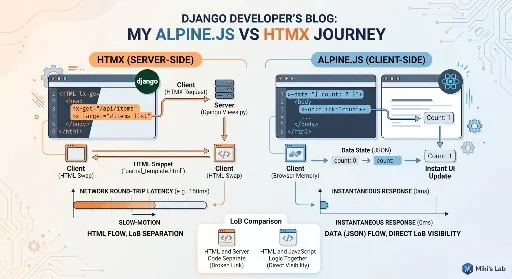
1. Background Knowledge: HTMX vs Alpine.js at a Glance
Before diving into the main discussion, I've put together a simple comparison table for those unfamiliar with these two concepts.
| Category | HTMX | Alpine.js |
|---|---|---|
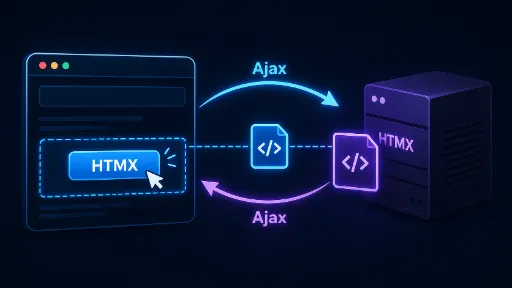
| Core Purpose | Server Communication (AJAX requests for HTML replacement) | Client-Side State Management (UI interactions) |
| Philosophy | HTML Extension (Server-centric) | Lightweight Vue/React (Browser-centric) |
| Data Format | HTML Snippets | JSON Data |
| Key Strengths | Infinite scroll, real-time search (SSR approach) | Modals, dropdowns, tab switching (CSR approach) |
2. Four Reasons Why I Gradually Started Avoiding HTMX
At first glance, HTMX seems incredibly convenient. However, the deeper I integrated it into projects, the more I encountered points of conflict with my development style.
① "Do We Really Need to Generate HTML Snippets on the Server?" (The Maintenance Dilemma)
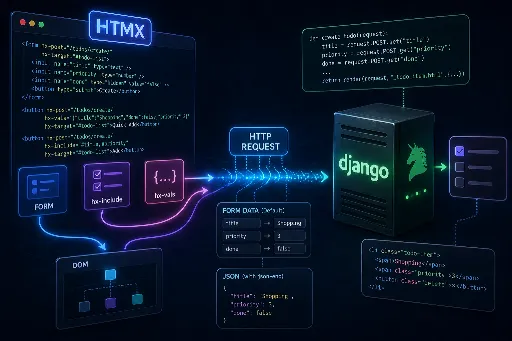
To use HTMX, the server (Django) needs to return HTML snippets instead of JSON. This didn't quite align with my preferences. * My Perspective: "Shouldn't the server cleanly provide only data, and the client handle rendering for clear separation of concerns?" * HTMX's Stance: "Receiving JSON and then re-rendering it is wasteful. The server providing the final output is the Single Source of Truth (SSOT)."
Adding conditional logic like if request.htmx: within Django templates made the view logic feel fragmented and messy, a feeling I couldn't shake.
② Isn't AJAX Logic Already Simple Enough?
HTMX's hx-get and hx-target are excellent 'syntactic sugar.' However, for someone who has already implemented AJAX with Vanilla JS or custom utility functions, they aren't essential.
Modern browser's fetch API is incredibly powerful. Just a single line of fetch within Alpine.js's x-init can produce perfectly declarative and clean code, which made me feel less compelled to follow another library's specific rules.
③ The Disruptive Break in "Locality of Behavior (LoB)"
I really like Alpine.js because what the code does is immediately visible right there. But HTMX is different.
* Alpine.js: The behavior is defined within the HTML, and the result happens instantly within the browser's memory.
* HTMX: The behavior is defined in the HTML, but to see the result (HTML snippet), you have to dig back into the server-side code (views.py).
I found this break in context to be very inefficient. The annoyance of constantly having to open backend files while reading code was one of the decisive reasons I started avoiding HTMX.
④ The Annoyance of Subtle Latency
HTMX assumes a network round trip for every interaction.
No matter how fast the server is, it can't match the immediate responsiveness of Alpine.js, which operates entirely within the browser. That subtle delay of 0.1-0.2 seconds felt with each click was quite bothersome from a user experience perspective.
In Closing: What Are Your Thoughts?
To summarize, I prefer a structure where data flows via APIs (JSON), and the UI reacts instantly within the browser. This is why I particularly favor the combination of Alpine.js and DRF (Django REST Framework).
Interestingly, looking at recent communities like Reddit, I've noticed many opinions quite contrary to mine. Many developers find Alpine.js complex and are returning to HTMX, or even a jQuery + HTMX combination. Regardless, it seems the popularity of HTMX is overwhelmingly high these days.
Of course, HTMX is an excellent tool. It simply didn't align with my development style and system design preferences. I truly believe that "there's no single right answer, only what fits you best."
What about you? Are you satisfied with HTMX's server-centric philosophy, or do you, like me, prefer JSON responses and the immediate responsiveness of Alpine.js? Share your thoughts in the comments!
Perhaps I steered clear of HTMX too soon, before truly grasping its full potential?


There are no comments.