Sign in
The H1 is empty, but for SEO we’ll use .
There are a total of 306 posts.
2026-03-12
Discover why instant search engine reflection for blog posts is crucial. Learn how IndexNow and the Mikihands Blog Platform solve this common frustration by automatically notifying search engines of new or updated content. Find out how custom domain users also enjoy these same essential benefits, ensuring your content is seen faster and more efficiently.
Frustrated by slow search engine indexing for your blog posts and website updates? IndexNow is a protocol that instantly notifies search engines of website changes, helping your content get discovered faster. Learn about IndexNow's principles, its necessity, how it differs from sitemaps, and which search engines support it in this comprehensive guide.
2026-03-10
A review of installing FlashAttention 2 on DGX Spark to improve model inference speed and GPU memory usage. This post shares the installation challenges, including source compilation on aarch64, and the actual performance and memory improvements observed after setup.
Discover a detailed guide to installing the high-performance MOSS-TTS model on the NVIDIA DGX Spark (Grace-Blackwell) environment. Learn how to achieve exceptional voice cloning performance without any fine-tuning and experience impressive power efficiency for your AI workloads. This guide covers setup, troubleshooting, and more.
2026-03-03
A detailed guide on why and how to build ONNX Runtime GPU on aarch64 systems. Covers CUDA 13, cuDNN installation, CMake configuration, wheel generation, and verification, providing DGX‑Spark users with an optimized build workflow.
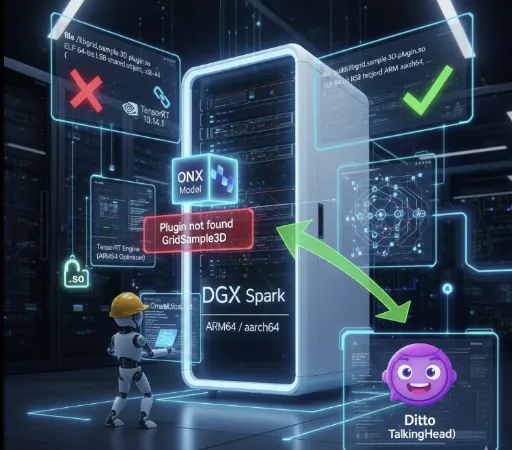
A step‑by‑step guide to porting the Ditto TalkingHead project to TensorRT on a DGX Spark ARM64 system. It covers diagnosing the x86 GridSample3D plugin load failure, rebuilding the plugin for ARM64, adjusting CMake, successful ONNX‑to‑TensorRT conversion, and final inference, providing practical troubleshooting for AI engineers.
After a 10‑hour deep dive into Tencent's HunyuanVideo-Avatar, I discovered it to be unfinished paperware plagued by memory leaks, outdated dependencies, and a broken CPU‑offload option. This post details the fatal bugs and warns developers against repeating the same mistakes.
Learn how to keep your Ubuntu Downloads folder tidy by using the system‑managed /tmp directory. This guide explains /tmp’s 30‑day cleanup rule, the daily timer, and a simple workflow for moving only needed files, ensuring automatic removal of temporary clutter.
2026-02-14
This report analyzes why Wake‑on‑LAN failed between two PCs on the same subnet after a router change, showing that limited broadcast (255.255.255.255) is blocked by the bridge while directed broadcast (192.168.0.255) works. It provides the command fix and a .bashrc alias to ensure reliable WOL in similar setups.
2026-02-12
Discover a custom Blue‑Green deployment script that enables zero‑downtime releases on low‑spec servers and Raspberry Pi devices. The guide covers pre‑emptive Celery shutdown, staged startups, health checks, and a human‑in‑the‑loop approval step to keep CPU usage low while ensuring reliability, with full Docker Compose code examples and operational tips.
2026-02-10
When Django Admin's default search returns too many unrelated hits, this mixin lets you search by specific fields using a `field:value` syntax and shlex for quoted terms. It preserves existing search_fields lookup rules while implementing AND/OR logic, dramatically improving search efficiency.
I discovered that Celery workers lack request.user and session data, rendering OAuth2, JWT, and session auth ineffective. By introducing API keys linked to users, I solved both authentication and identification, and gained operational benefits like easy key management, rotation, and user‑based billing.
2026-02-02
Explore when to use simple_tag in Django templates. Learn the criteria for separating view logic from template formatting, avoid ORM in tags, and see practical examples. This guide clarifies responsibilities, improves maintainability, and boosts performance.
Explore Python’s built‑in math and statistics modules to handle floating‑point quirks, rounding, isclose, fsum, combinatorics, weighted means, and more. Practical examples and common pitfalls are covered for beginners and professionals alike.
Explore Python’s built‑in random module for selecting, sampling, shuffling, and weighted choices, plus how to achieve reproducibility with seed or Random instances. Learn why secrets is the right tool for cryptographic‑safe randomness.












![[Python Standard Library - 5] Working with Numbers: Using math and statistics](/media/editor_temp/6/b61bc8e3-5ac9-46fd-b6e2-129e91d7931b.png)