What Is a Reverse Proxy? A Quick Guide to Forward vs. Reverse Proxies, Their Purposes, and Use Cases
1. First, Let’s Clarify What a Proxy Is

A proxy server is an intermediary “agent” that sits between a client and a server. Instead of the client reaching the server directly, the client sends its request to the proxy, which then forwards the request to the server and returns the response back to the client.
The role and name of the proxy change depending on which side it stands on:
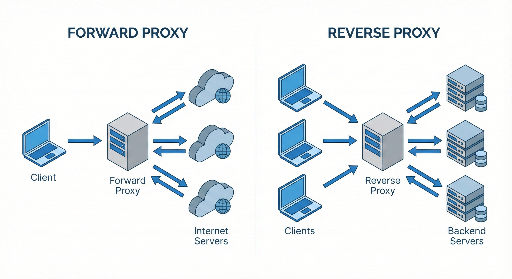
- Forward Proxy – stands on the client side and handles outgoing requests to the internet.
- Reverse Proxy – stands on the server side and handles incoming requests from the internet.
2. Forward Proxy: The Client‑Side Agent
When people think of a proxy, they usually mean a forward proxy.
2.1 How It Works
Client → Forward Proxy → Internet (various servers)
- The client never talks directly to the internet; it talks to the forward proxy.
- The forward proxy sends the request to the external server on behalf of the client and returns the response.
2.2 Common Uses
- Hide the client’s IP – external servers only see the proxy’s IP.
- Access control / filtering – blocking sites like YouTube or social media in corporate or school environments.
- Caching – store frequently accessed web pages to save bandwidth and speed up access.
- Logging & monitoring – record who accessed what and when.
2.3 Examples
- Corporate or school internal proxy servers.
- Web proxies that bypass country‑based blocks.
- Some VPN services that forward client traffic.
In short, a forward proxy is used when a client needs to go out to the internet.
3. Reverse Proxy: The Server‑Side Agent
A reverse proxy is the opposite: it sits in front of the server. Clients send requests to the reverse proxy, which then forwards them to the appropriate internal server.
3.1 How It Works
Client → Internet → Reverse Proxy → Internal servers (web, API, etc.)
- The client requests
https://example.com. - DNS points to the reverse proxy, not the actual web server.
- The reverse proxy performs: * Load balancing * Authentication/authorization * Caching * Security checks (WAF)
- It forwards the request to one of the internal servers (A, B, or C).
- The internal server’s response goes back through the reverse proxy to the client.
3.2 Why “Reverse”?
Because the direction is opposite to a forward proxy:
| Proxy | Position | Flow |
|---|---|---|
| Forward | Client side | Client → Forward Proxy → External Server |
| Reverse | Server side | Client → Reverse Proxy → Internal Server |
Thus the name “reverse” reflects that the proxy is on the server side, handling inbound traffic.
4. Quick Comparison
| Feature | Forward Proxy | Reverse Proxy |
|---|---|---|
| Position | Between client and internet | Between internet and internal servers |
| Focus | Client protection / control | Server protection / optimization |
| Main purposes | IP hiding, access control, filtering, caching | Load balancing, SSL termination, security, caching, URL routing |
| Security view | Protects internal network when clients go out | Hides internal servers from the outside |
| Typical users | Corporate IT, general users | Service operators, backend engineers |
| Common examples | Internal proxy, web filter, some VPNs | Nginx, HAProxy, AWS ALB, Cloudflare, Akamai |
5. What Does a Reverse Proxy Do? (Key Features)
Let’s dive into the main functions of a reverse proxy.
5.1 Load Balancing
Problem – A single web server can’t handle all traffic.
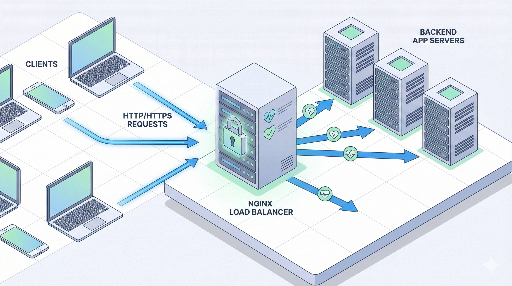
Solution – The reverse proxy distributes incoming requests across multiple servers using strategies like Round Robin or Least Connections. It can also perform health checks to avoid sending traffic to dead servers.
Example – Nginx or HAProxy as a load balancer in front of several application servers, or AWS ALB.
5.2 SSL/TLS Termination
Problem – Each web server would need to handle HTTPS, increasing CPU load and certificate management overhead.
Solution – The reverse proxy terminates HTTPS, decrypts traffic, and forwards it to internal servers over HTTP (or internal TLS if desired). Certificates are managed only at the proxy.
Example – https://example.com traffic ends at an Nginx reverse proxy, which then forwards to http://app1:8080 or http://app2:8080.
5.3 Security (WAF, Firewall, Server Hiding)
Problem – Web applications are vulnerable to SQL injection, XSS, DDoS, and you may want to hide internal server details.
Solution – A reverse proxy can act as a Web Application Firewall, filtering malicious requests, allowing only permitted paths or methods, and keeping internal servers on a private network.
5.4 Caching
Problem – Static assets (images, CSS, JS) are requested frequently, and hitting the backend each time is wasteful.
Solution – The reverse proxy caches static files at the proxy level, reducing backend load and speeding up responses. CDNs like Cloudflare or Akamai are essentially reverse proxies with caching.
5.5 URL Routing / API Gateway
Problem – A single domain hosts multiple services (web, API, admin panel) or a micro‑service architecture has many backends.
Solution – The reverse proxy routes requests based on domain or path:
/api→ API server/admin→ Admin server/static→ Static file server
It can also perform authentication, rate limiting, and other gateway functions.
Example
https://example.com/        → web‑frontend service
https://example.com/api/    → api‑gateway service
https://example.com/admin/  → admin‑backend service
6. When to Use Which Proxy?
6.1 When a Forward Proxy Is Needed
- Corporate or school environments that need to control or monitor employee web access.
- Public institutions blocking specific sites.
- Consolidating outbound traffic for a single exit point.
- Clients wanting to hide their IP from external servers.
Keywords – client protection, internet usage management.
6.2 When a Reverse Proxy Is Needed
- Scaling web services with load balancing.
- Centralized SSL certificate management.
- Adding a security layer without exposing internal servers.
- Caching static resources for performance.
- Routing multiple backend services under one domain.
- Implementing an API gateway or edge proxy in a micro‑service setup.
Keywords – server protection, scalability, operational convenience, performance optimization.
7. Takeaway
- A proxy server acts as an intermediary between a client and a server.
- Forward Proxy – sits on the client side, handling outgoing requests.
- Reverse Proxy – sits on the server side, handling incoming requests.
- Reverse proxies are essential for load balancing, SSL termination, security, caching, and routing in modern web deployments. Popular choices include Nginx, HAProxy, AWS ALB, Cloudflare, and Akamai.
There are no comments.